
We are excited to announce that Dr. Oisín Plumb has been awarded funding from The British Academy Neil Ker Memorial Fund. This support will facilitate his intriguing research into “The Macrobian Orcades: A View from Britain.” Congratulations.
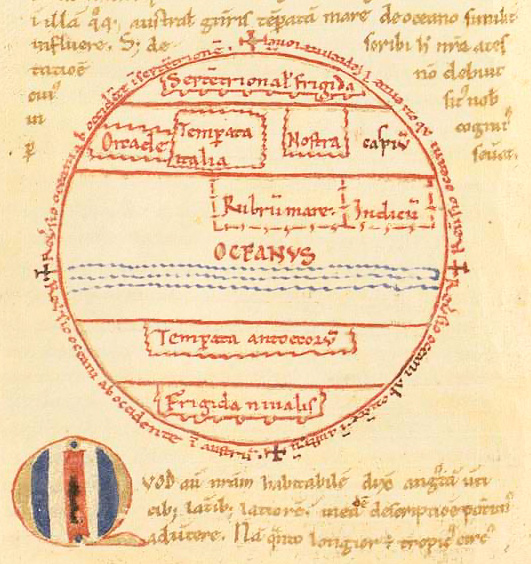
This research examines the representation of the ‘Orcades’ in Macrobian zonal maps found in manuscripts with insular connections. These maps illustrate the climatic zones of the earth as outlined in Macrobius’s commentary on Cicero’s “Dream of Scipio,” written around AD 430. Notably, a significant number of these maps—13 out of the 35 surviving pre-1100 Macrobian zonal maps—include the ‘Orcades.’ They are typically one of only two named locations in Europe, the other being ‘Italia.’ This suggests a cosmological view of the Orcades as the earth’s outermost inhabited region, representing an abstract cosmological idea rather than a concrete geographical place.
Variations include the number of islands depicted, their placement within different climatic zones, and their relationship to other locations. This study will evaluate how the proximity to the Northern Isles of Scotland, along with the understanding of these islands as real and tangible places, has influenced the creation of visual representations within a cosmological tradition that shaped the worldview of medieval Europe. This work will complement Dr Plumb’s recent research funded by the Strathmartine Trust, which focused on Macrobian Maps of central European origin within Italian archives, offering the opportunity to compare the ways in which proximity or distance to Northern Scotland affected the portrayal of the ‘Orcades’ in these maps.
The project builds on research conducted by Dr. Plumb in his paper titled “Where were the Orcades? Early medieval engagement with the islands at the edge of the Earth in texts and maps.” In this published work, he examines how the Orcades and the North Atlantic are portrayed in various seventh- to eleventh-century insular sources. Dr. Plumb argues that the early medieval written sources from the insular region suggest that the term “Orcades” should not always be translated as “Orkney.” Instead, it is likely that, in many instances, it refers to a broader area that includes multiple island groups in Scotland. This conclusion is further supported by the representation of the Orcades on the mappa mundi in British Library Cotton MS Tiberius B.v/1.
Recent multi-spectral images of the map indicate that, despite some apparent modifications to the size of the Orcades made during the map’s creation, there was an intention to depict a large archipelago covering a vast area off the northern coast of Britain from the outset.
Dr Plumb said, ‘It is a great honour and privilege to receive this funding from the British Academy to investigate portrayals of the Orcades in maps with strong links to Britain and Ireland. Throughout medieval Europe, the ‘Orcades’ had a reputation as a place right on the edge of human civilisation. To a cartographer in Italy, it would have seemed an almost otherworldly place. However, those composing maps in Britain or Ireland would have also known the islands as a place with very real political and cultural concerns. This funding will allow more details of medieval mapping’s fascination with Scotland’s northern islands to be uncovered’.
Thanks to The British Academy and the Neil Ker Memorial Fund.

If you feel inspired to join us at UHI Institute for Northern Studies then drop us a line on ins@UHI.ac.uk ,contact us through our website or our social media platforms.
Leave a Reply