

Orkney is blessed with a vast array of archaeological sites from various time periods, including numerous examples from the Viking Age. A site-type which often gets a lot of publicity but rarely has visitors are Viking burials. Many of these sites are publicly accessible, providing a nice focus for a somewhat different day out. All of the Viking burial sites in Orkney which can be located with a reasonable degree of certainty can be found, with photographs and maps (including those in this article), on a blog I created in 2015: Viking Burials in Scotland | Landscape and burials in the Viking Age (wordpress.com).

The dating of the arrival of sea-pirates, traders and settlers from Scandinavia remains a contested issue, but the earliest burials appear to be dated from c.850 AD, recognisable by their difference from pre-Viking Age burials. These differences include cremation (along with inhumations), the use of grave-goods, and burials under new mounds or in existing ones. All or some of these attributes may be present. A coin of the English king Edmund (r. 939-946) found in the burial of a middle-aged male in a mound which had formed over the remains of an earlier Viking-Age house at Buckquoy, close to the Point of Buckquoy carpark, demonstrates that Viking-style burial continued until at least the mid-tenth century. The famous boat burial at Scar on Sanday may be from a similar time.
The burials are quite evenly distributed across Orkney, although not all islands (currently) have a burial that can be located with any certainty. However, new burials continue to be found and our knowledge is constantly in flux, highlighted in 2015 with the discovery of two Viking inhumations on Papa Westray, from which no certain burials were previously known. As with most Viking burials in Scotland, all of those in Orkney are coastal, highlighting the importance of the sea and maritime routes to the Norse. The exception is a probable cremation burial under a mound with 64 beads and a brooch in a field north of Harray churchyard. It is of some interest that this non-coastal burial overlooks Lochs Harray and Bosquoy, which may have been part of an inland waterway through Orkney Mainland during the Viking Age and Norse periods.
But how many of the sites can be visited today? Many of the burials were found by antiquarians, and their exact locations are no longer known, but the general area often is. For example, four inhumations were found in the mid-nineteenth century at the Sand of Gill on Westray, with grave goods including a sword, axe, shield, a horse and part of another and part of a dog. Although the exact location of these burials is unknown, visiting the Sand o Gill provides a good idea of the landscape of the burials and the views from them of Pierowall Bay. Other burials have a known exact location, but there is no longer anything to see due to erosion or removal, such as the burials along Brough Road, Mainland, excavated in the late 1970s. However, some visible burial sites exist which are relatively easy to see and make for a somewhat different Orkney excursion.
The easiest burial site to visit is at the ancient outer entrance to the Broch of Gurness, where the stone-lined Viking grave has been reconstructed. The burial was notable for including a pair of oval brooches (suggesting but not proving a female burial) and a neck-ring of amulets that included a Thor’s hammer, a style of jewellery most commonly found in Sweden. Burial with a neck-ring of amulets, including one presumably invoking the god Thor, is a pertinent reminder that those buried were often immigrants with a different religion to the local population. Pieces of skull, an amber bead and a ringed pin found between the defensive ramparts in the South-West suggest at least one more Viking burial in the broch. Another burial near an easily accessible tourist site is the one at the southern end of the Bay of Skaill, south of the prehistoric settlement at Skara Brae. The burial, excavated in 1888 and including a spear and a comb in a case, is thought to have come from the eroding multi-period settlement mound which can be seen from the beach (look for different layers in the cliff face).
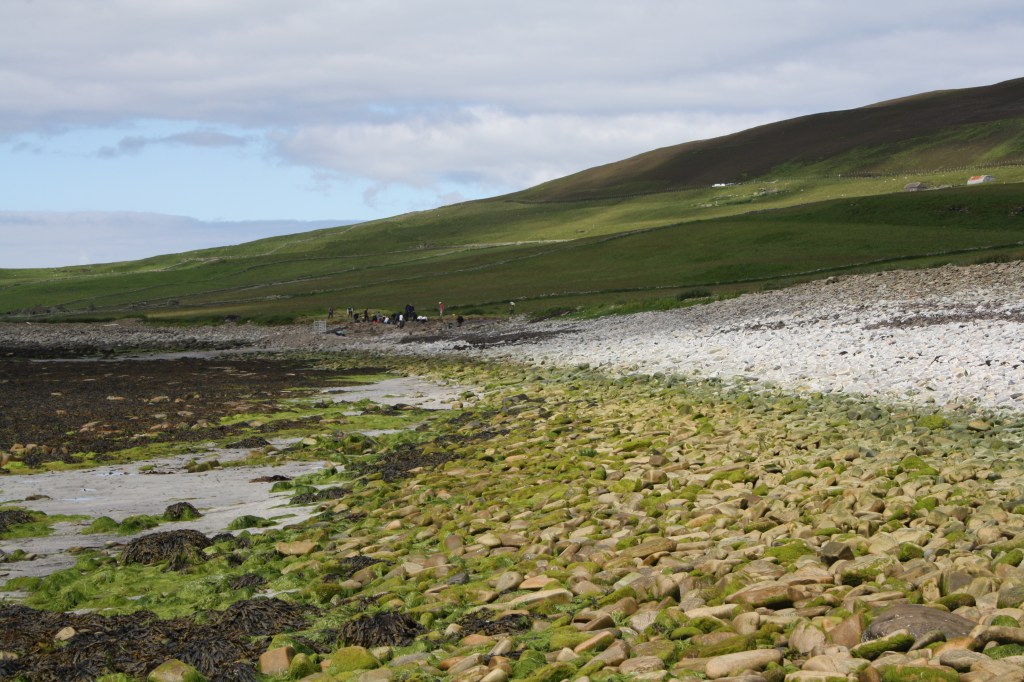
Amongst the islands, a burial which is visually spectacular is at the Styes of Brough, Sanday. The site includes four prehistoric mounds, and in one a Viking Age sword was discovered in the nineteenth century. Excavations by the Time Team television program in 1997 found a boat-shaped stone setting inserted into one of the mounds along with a fragment of human bone, making this the likely origin of the sword and a Viking burial. The site is on private land, but if they prove to be difficult to reach when you visit, the four mounds are visible from many spots along Coo Road, including the Ayres Rock Hostel and Campsite (binoculars recommended!). A final site to mention is the Viking- and pre-Viking Age (in use from the seventh century) cemetery at Westness in the Bay of Swandro, Rousay. The Viking Age burials included two boat graves and two oval-shaped stone settings, along with other burials. An interesting feature of the cemetery is that the Viking graves respected the earlier pre-Viking Age burials. Although nothing of the cemetery itself is now visible, it is only a few hundred metres south of a multi-period settlement site, including Viking Age, which has been under excavation since the 2010s and should be visible.
Of course, there are many other Viking-related sites worthy of a visit, including the remains of Viking buildings on the Brough of Birsay, the remains of the Viking settlement on the Brough of Deerness, Cubbie Roo’s castle remains on Wyre, Earl’s Bu and church at Ophir, St Magnus Cathedral in Kirkwall, and searching for the rune inscribed standing stone at the Ring of Brodgar.
Dr Shane McLeod, Post Doctoral Research Associate, Institute for Northern Studies
This article first appear in the Islander Magazine in April 2023
 Odin's Eye Blog
Leave a reply to Archaeology 2023-06-30 – Ingram Braun Cancel reply