

Dr. Oisín Plumb, a lecturer at the UHI Institute for Northern Studies, recently had the incredible opportunity to travel to Italy for archival research, thanks to the generous funding from the Strathmartine Trust’s Sandeman Award. The purpose of the journey was to study manuscripts in three remarkable archives, with a specific focus on ‘Macrobian Zonal Maps.’
These captivating medieval maps depict the world divided into climatic zones, a concept discussed in Macrobius’s commentary on Cicero’s “Dream of Scipio,” written around AD 430. The simplicity of these maps is fascinating; they only include a few labelled locations, primarily highlighting significant seas and landmasses.
Notably, the term “Orcades” appears frequently. In medieval texts, it sometimes refers specifically to Orkney, but at other times, it includes a broader range of areas, such as Shetland and even the Western Isles. Remarkably, Orcades is often one of only two European place names featured on the maps, and at times, it stands as the only place name on the entire map!
It was a whirlwind week as Dr Plumb examined 18 medieval maps across three archives. First, he was granted access to the Biblioteca Nazionale Di Napoli, a breathtaking library located within the historic Royal Palace of Naples, with stunning views of Vesuvius across the bay.
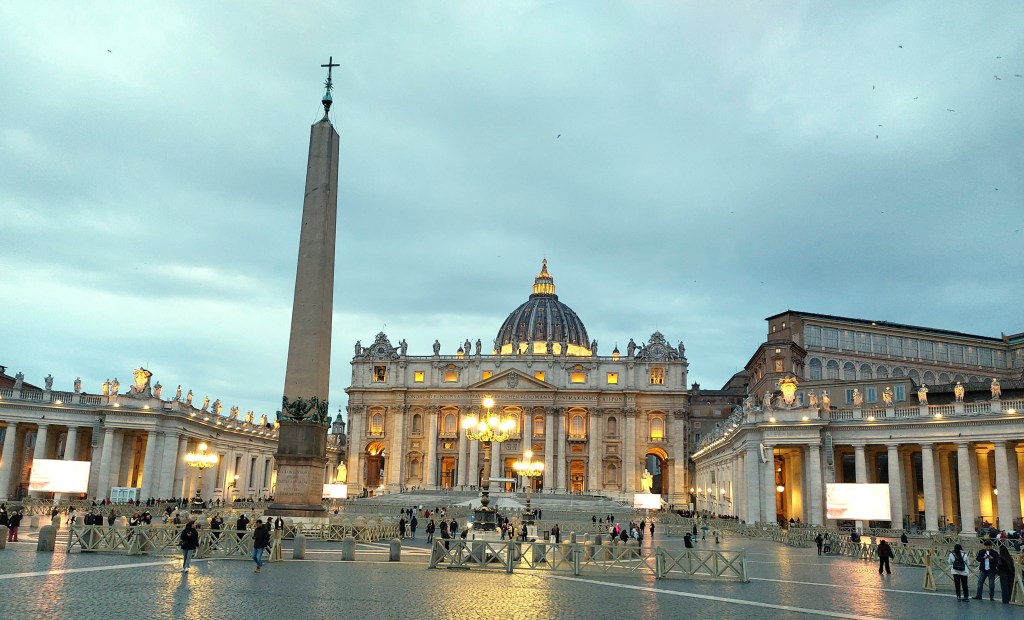
Next, Dr Plumb visited the Vatican Apostolic Library, famed for being one of the largest collections of manuscripts in the world. Situated in a rarely accessed area of Vatican City, its history dates back to the fourth century, although it was formally established as we know it in 1475.
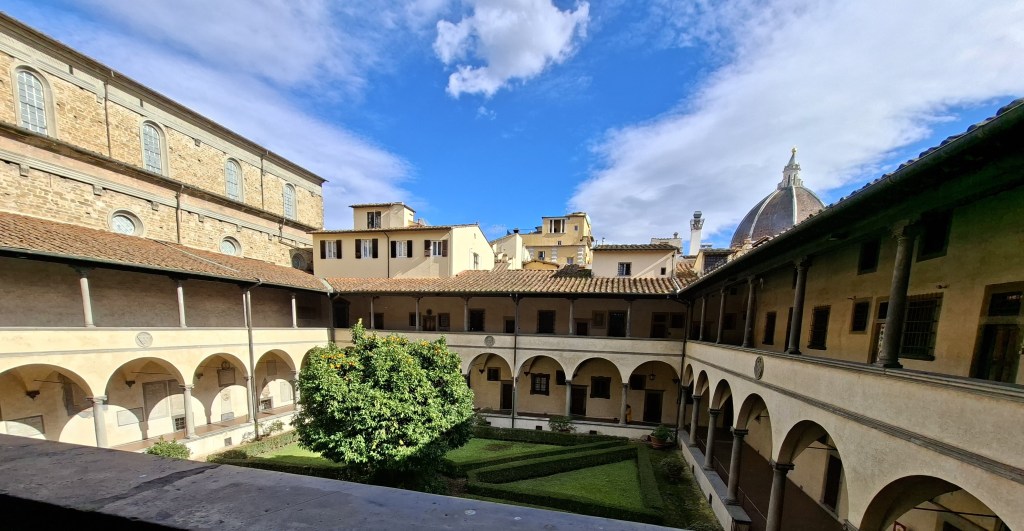
Finally, Dr Plumb spent time at the Biblioteca Medicea Laurenziana in Florence, which originated from the private manuscript collection of the influential Medici family and is nestled off the cloisters of the beautiful Basilica di San Lorenzo.
Reflecting on his experience, Dr Plumb said, “Working with medieval maps in such incredible historic archives was an unforgettable experience. It was amazing to see first-hand the ways that the Northern Isles of Scotland appear time and time again as important markers of the edge of the known world, even on the most minimalistic maps. To some of the central European scribes who drew many of these maps, the islands must have seemed distant and almost otherworldly, yet their regular inclusion highlighted their significance as boundaries of the known world. I am immensely grateful for the support from the Strathmartine Trust and am eager to share the findings of this research in published form very soon!”
The feature image is St Peter’s Basilica, Vatican City. Source: S Page.
If you feel inspired to join us at UHI Institute for Northern Studies then drop us a line on ins@UHI.ac.uk ,contact us through our website or our social media platforms.
 Odin's Eye Blog
Leave a comment