

I’m incorrigible when it comes to this kind of thing. Last year marked the centenary of The National Library of Scotland. As part of the celebrations, NLS curated an exhibition called Dear Library – ongoing until 18th April – in which all and sundry were invited to submit their memories of Scottish libraries and the books that shaped them.
Obviously, I dashed off a contribution in no time (though in a considered, thoughtful manner, you understand).
I have recently completed my MLitt in Viking Studies through UHI Institute for Northern Studies (marvellous fun it was too). My journey to that began, though, nearly half a century ago, in the library of Thurso, the most northerly town on the Scottish mainland, where I grew up (Thurso, that is, not the library, although it sometimes felt like it).
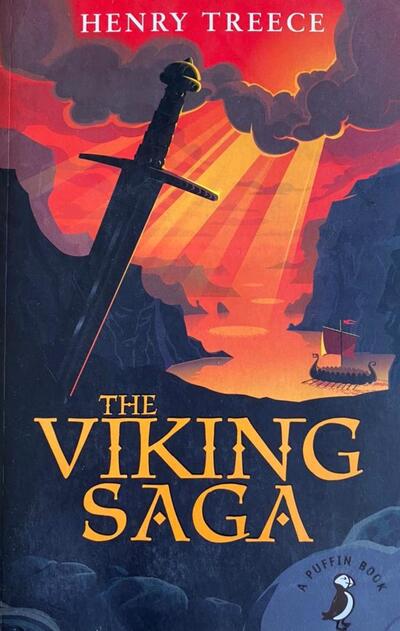
However, although I was surrounded by street names resonant of Caithness’ Norse past – Sigurd Road, Thorfinn Terrace, Hakon Road – I’m slightly ashamed to say that my fascination for all things Viking was really inspired by borrowing from Thurso Library the children’s historical novels of Staffordshire-born Henry Treece.
First, I read The Burning of Njal, in which Treece correctly assumed that children would be captivated by a retelling of the famous Icelandic saga, in which a bloody feud leads to the elderly titular character, his wife and their young grandson being immolated together in bed.
Of course, I was hooked.
What absolutely sealed it, though, was Treece’s Viking Trilogy, which told the life-story of an inevitably blonde Norwegian called Harald Sigurdson. In the first volume, Viking’s Dawn, Harald goes youthfully off on a Viking raid to Scotland, surviving some sticky situations in the Hebrides (what’s new?).In the second, The Road to Miklagard, he joins the Byzantine emperor’s Varangian Guard, having further adventures in Gibraltar and Russia along the way.
And, obviously, in the final one, Viking’s Sunset, Harald sails, as an old man, to America, where he dies in battle.Just your average Viking life, in other words.
I would say, though, that for all the high-octane bloodshed, it wasn’t the violence and gore that appealed to my ten-year-old self. In fact, I’ve never been interested in the whole battle-reconstruction, heroic-warrior-who-looks-like-he’s-in-a-heavy-metal-band take on Vikings (even though their haircuts were probably more redolent of late-80s Madchester than early-70s Birmingham).
I think what really captivated me was the mind-blowing distances they travelled, from Asia to Ukraine, to Turkey, to Iceland, to Canada. Also, the saga literature; that there was this unique body of work – albeit written, in many cases, centuries later – which gave us insights into the stories, lives and personalities of individuals not strictly paralleled in any other historic culture.
And Henry Treece’s novels were my route into this.
Sadly, his works have been out of print for decades. But it was nice that the NLS’ lovely exhibition gave me the chance to pay homage to the man who sparked my love of those often indefensible, sometimes unbelievable, frequently exhilarating and always entertaining tales of the Vikings.
Skál, Henry!
If you feel inspired to join us as a postgraduate or as an undergraduate student then please feel free to email us at ins@uhi.ac.uk or visit our website
 Odin's Eye Blog
Leave a comment