

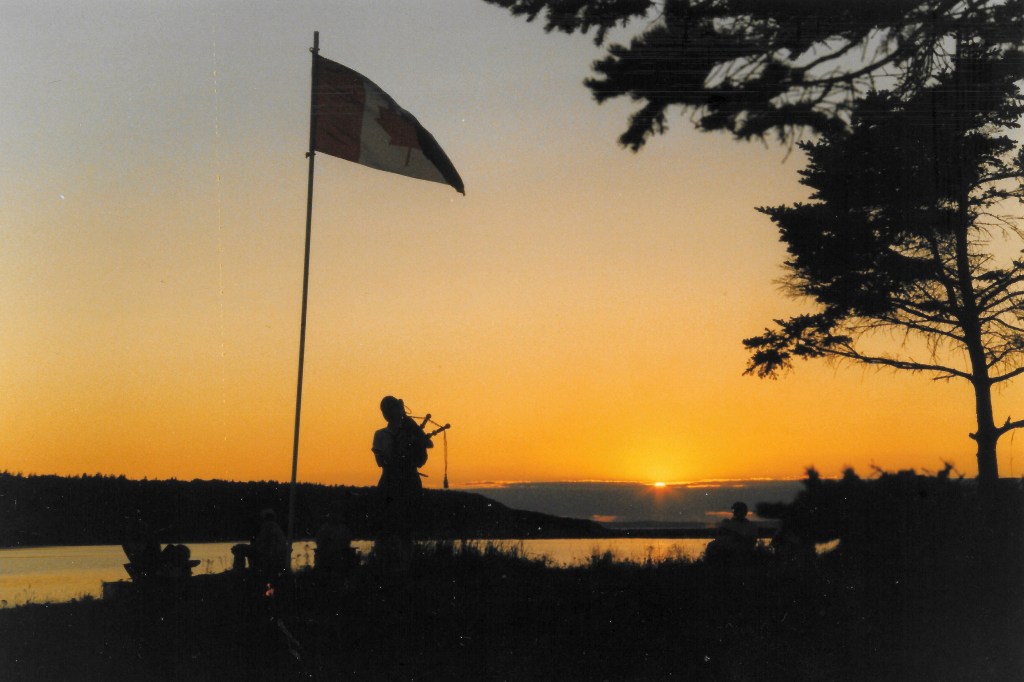
In this blog, UHI Institute for Northern Studies student, Hazel Gunn, studying BA Hons in Culture and Heritage, outlines the findings of her research.
The Gaelic tradition of bagpiping in Nova Scotia began with the arrival of people from the Highlands and Islands who emigrated to escape from poverty and oppression and seek a better life. The emigration of whole communities spanned a period from 1773 to circa 1850 and while these people were not the only people to emigrate to Nova Scotia, they did form the majority ethnic group and embedded their Gaelic cultural identity into the communities they set up.
My research has shown that the emigrant pipers who formed part of these communities would have played in the traditional Gaelic style, which reflected the melodic, stylistic and lyrical overlap between the Gaelic language and its music. Due to the remoteness of these communities, their culture remained free from external influences for many years.
Despite this, by the beginning of the 20th century several interconnected factors led to the decline of the tradition. These factors included the decline in the use of the Gaelic language. Traditional Gaelic bagpiping was an oral tradition taught by demonstration and by singing the tune, so it is clear how the transmission of tunes could be impacted by the loss of the Gaelic language. There has been a dramatic decrease in the number of Nova Scotians speaking Gaelic since 1901 and this, together with the introduction of the written score, has significantly impacted on the tradition’s connection to the Gaelic language.
Not everyone agrees with this viewpoint and it has been suggested that the Gaelic sound has been built into the music itself, so there is no requirement to be able to speak the language in order to play. Whilst this might be true in terms of being able to copy a style of playing, without knowledge of the rhythmic phrasing that is part of the Gaelic language, and which gives the music its uniqueness, it is difficult to understand how you could put your own interpretation on the music or create new music without speaking the language.
Other factors which led to the decline of the Gaelic tradition of piping included the migration of people from rural areas to urban centres for employment, a movement towards an increasingly Anglo-centric society; the demeaning of the Gaelic culture; the role of the Army in exposing pipers to non-Gaelic styles of playing, and perhaps, most significantly, the influence of modern Scottish piping styles.
My research has shown that the Gaelic tradition of piping in Scotland underwent meaningful change due to the influence of the Highland Society of London. It introduced competitions and the written score as a way of preserving what it thought was a tradition in decline. This led to a standardisation of the Gaelic tradition in music, interpretation and playing styles, together with a narrowing of the repertoire and emphasis on technique, all of which moved the tradition away from its Gaelic roots. This was described as the modern Scottish style, and it prevailed in most of Scotland from the late 19th century.

It has also been shown that this style of playing influenced pipers of Nova Scotia in the 20th century through the immigration of Scottish pipers, Army tuition and the Cape Breton Gaelic College focussing on employing Scottish instructors who had no understanding of the Nova Scotian or Scottish Gaelic tradition to oversee piping courses.
This modern Scottish style of playing is still at the forefront in the competition circuit and in the pipe band scene both in Scotland, Nova Scotia and further afield. However when exploring the position of the Gaelic tradition in Nova Scotia and Scotland today, the research identified pipers who felt there was a place for both traditions of playing. It would very much depend on the purpose of the playing, competition and pipe band or entertainment and dancing, which style you could decide to pursue further.
One of the principal factors in assuring the Gaelic tradition continued in Nova Scotia was the value the community placed on music and dancing, and in particular step dancing. Although the fiddle took over from the bagpipe as the main instrument for dancing to, it was pipe tunes that were still played, adapted for fiddle. This ensured that the music survived, and this research has discovered that the pipes are now re-emerging as an instrument for dancing to.
This is not the case in Scotland, where changes to dancing styles and a slowing down in tempo to accommodate increased ornamentation both in the dancing and the music, meant that traditional Gaelic piping tunes were no longer needed. My research has identified that it is only in the culturally conservative areas of the Highlands and Islands that the Gaelic tradition of piping remains a part of the community. Opportunities for playing in the Gaelic style appear to be a critical factor in keeping the tradition alive, and interviewees talked about a burgeoning traditional music scene where the Gaelic tradition of playing can be utilised and is enjoyed by a growing audience.

In conclusion, it is my view that the tradition of bagpiping in Nova Scotia did remain truer to its Gaelic roots for a longer period than in Scotland. However, to imagine that the tradition has remained unchanged in Nova Scotia from the arrival of the first emigrant pipers on the Hector to current times is not the case, and this research paper has highlighted that changes did occur. Of significant note was the persuasive impact of the modern Scottish style, but the old Gaelic tradition was not eradicated completely and the recent revitalisation is evidence of this.
It is important to acknowledge that the Gaelic tradition of bagpiping in Nova Scotia, and particularly in Cape Breton, is its own form of Gaelic bagpiping. It has not been preserved as a relic from 18th century Highlands and Islands but has moved and evolved within its own unique circumstances, within the Gaelic aesthetic of Nova Scotia.
Feature photograph source: Wiki Commons
If you feel inspired to join our research as a postgraduate student or as an undergraduate then please feel free to email us at ins@uhi.ac.uk or visit BA (Hons) Culture and Heritage course
 Odin's Eye Blog
Leave a comment